
Does Smarter Road Maintenance Posts Cut CO2 emissions? What the Evidence Says
Rough roads burn more fuel, and fixing them burns carbon too. Photo and video data can show you where to act. It cannot tell you what the fix costs in CO2. That's where an emissions data layer helps.


The short version: Yes, in two ways, but the evidence on road maintenance emissions needs extra information. A rougher road costs vehicles fuel: in US modelling, each extra 1 m/km of roughness added about 1% to a truck's fuel use at highway speed and about 2% for a car. Fixing a road early with a light treatment uses much less energy than rebuilding it, according to one review, and reclaimed asphalt can avoid roughly a quarter of a job's emissions. Camera data from a vehicle makes it cheap to see the whole network. What it does not give you is the carbon cost of the repair itself, including the trucks that haul the material. That needs its own, auditable count.
IN THIS ARTICLE
- Why is road maintenance a carbon question?
- What does photo and video data change?
- Which fix produces the least carbon?
- Where does moving material come in?
- What should a road agency ask a bidder?
- What else do people ask?
Why is road maintenance a carbon question?
Two reasons, and they pull in different directions. A poor surface makes every vehicle that uses it burn more fuel. And repairing it uses materials and machines that emit carbon of their own.
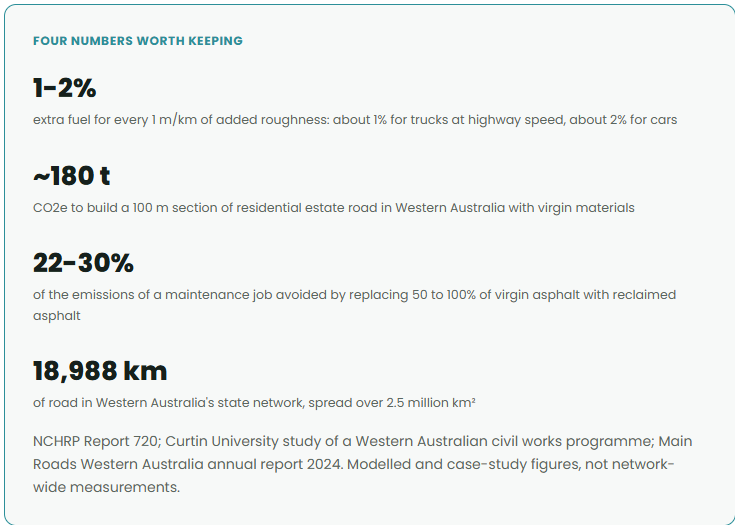
On the first, the US National Cooperative Highway Research Program (Report 720) modelled the effect of pavement roughness, measured as the International Roughness Index, or IRI. For each 1 m/km rise in IRI, fuel use went up by about 2% for passenger cars at any speed. For heavy trucks it was about 1% at highway speed (96 km/h) and about 2% at low speed (56 km/h). The report calls roughness the most important pavement factor for fuel use.
On the second, the scale of what traffic emits dwarfs what the roadworks emit. A Transport Scotland study of local roads found that emissions from vehicles running normally were much larger than those from the works themselves. So a repair can be worth doing for carbon reasons even though the repair is not free of carbon. How much it is worth depends on how much traffic uses the road.
What does photo and video data change?
It changes how often you can look, and how consistently. The old way sends inspectors out to photograph suspected damage. The newer way mounts a smartphone or camera on a vehicle, records as it drives the network, and uses computer vision to flag and grade defects.
One published example is a Finnish regional road authority, the Häme centre, which adopted RoadAI, a smartphone-video tool, five years ago. It replaced contractor inspectors driving out to photograph suspected damage. Results now appear on a web map within hours, and damage is classified the same way every time, where human surveyors vary. A maintenance manager there says checking a district takes less than a minute. The write-up is on a vendor-linked site and gives no savings figure, so treat it as a description of the method, not proof of the return.
What this data gives you is where the damage is and how bad. That makes it possible to act while the damage is small, instead of waiting until it forces a larger repair. It does not tell you what the repair emits, which needs a second count.
Which fix produces the least carbon?
The research points one way: lighter and earlier beats heavier and later. A review of preservation treatments such as surface seals, thin overlays and crack sealing, summarised on TRID, found they use much less energy and give significantly lower greenhouse gas emissions than rehabilitation or reconstruction, once you account for how much life each one adds. We could read only the abstract, so we cannot give you the figures.
Materials matter too. The Curtin University study of civil works in Western Australia found that replacing 50 to 100% of virgin asphalt with reclaimed asphalt during maintenance avoided about 22 to 30% of the greenhouse gas emissions of that work. A fully reused crushed rock base, recycled concrete rubble and a 15% reclaimed asphalt mix together cut the total by about 6%. Recycled brick as a road base did not reduce the emissions from making and moving the material, though it may help in other ways.
None of this tells a road agency which road to treat first. By our reasoning, not a published finding, the fuel saving from a smoother surface grows with the amount of traffic, especially heavy traffic. A repair on a busy freight route should save more fuel than the same repair on a quiet road. So condition data, traffic data and a carbon count need to be read together, not on their own.
|
Finding |
Source |
Limit to keep in mind |
|---|---|---|
|
Rougher roads raise fuel use |
NCHRP Report 720 |
US modelling. Geographically, roads and heavy fleets differ |
|
Traffic emissions are much larger than roadworks emissions |
Transport Scotland |
Scottish local roads, modelled; no single headline figure |
|
Preservation uses far less energy than rebuilding |
TRID review |
Abstract only; per area treated |
|
Reclaimed asphalt avoids 22-30% |
Curtin University |
One Western Australian case study |
|
Video inspection is faster and more consistent |
Häme road authority |
Vendor-linked write-up; no savings figure |
Where does moving material come in?
Into the trucking. A maintenance programme is also a freight job, and this part is our reasoning, not a study. Asphalt, aggregate, binder and plant have to be trucked to site, and on a network as spread out as Western Australia's the distances can be long. Each of those loads is a cargo movement with an emissions figure attached.
Counting those movements is what we do. CaDi is a data layer for low-carbon logistics. It captures a movement once, calculates its emissions using its own calculation engine based on GLEC v3.2 and ISO 14083, and keeps an auditable record of how the number was reached. For a road agency, that would mean the haulage in a maintenance programme counted the same way, load by load, rather than as a rough average. Averages mislead in shipping too: our EU ETS post showed one trade-lane average overstating a single voyage's figure by 47.6% (VesselBot, modelled).
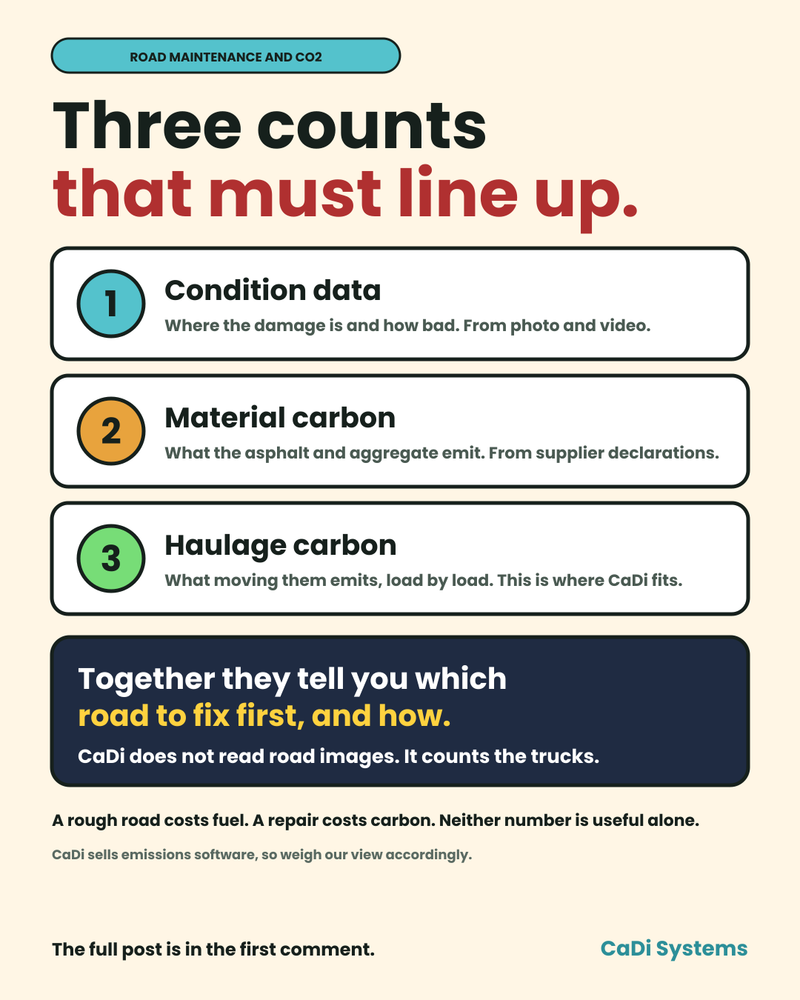
CaDi does not read road photos or video, and it does not produce the embodied carbon of the asphalt itself, which comes from the material supplier's own declarations. In practice three counts have to line up: the condition data, the carbon in the materials, and the carbon in moving them. CaDi sells emissions software, so weigh our view accordingly.
What should a road agency ask a bidder?
If you are buying road monitoring or maintenance planning with a carbon claim attached, a few plain questions separate a real method from a slide:
- What exactly is measured, and by what? Roughness, cracking and rutting from camera data are different measures, and each has an error range.
- How do you turn condition into carbon? Ask for the fuel and traffic assumptions, and who has checked them.
- Is the haulage counted, and by what method? Ask for load-level figures and a named standard, not an average.
- Where do the material figures come from? Supplier environmental declarations are better than generic factors.
- What was the baseline, and who can audit it? Without one, there is nothing to measure a saving against.
What else do people ask about road maintenance and CO2?
What is IRI in road maintenance?
The International Roughness Index, a standard measure of how rough a road surface is, in metres of vertical movement per kilometre. A higher number means a rougher ride. Researchers use it to estimate how much extra fuel and wear a road causes.
How much extra fuel does a rough road use?
In US modelling for the National Cooperative Highway Research Program, each 1 m/km rise in roughness added about 2% to a passenger car's fuel use, and about 1% to a heavy truck's at highway speed (96 km/h) or about 2% at 56 km/h. Real figures depend on the vehicle, speed, load and how rough the road already is.
Does preventive road maintenance save CO2?
Research suggests so. A review of pavement preservation treatments found they use much less energy and give significantly lower greenhouse gas emissions than rehabilitation or reconstruction, after allowing for the life each treatment adds. Using reclaimed asphalt avoided about 22 to 30% of a maintenance job's emissions in a Western Australian study.
Can AI analyse road photos and video to plan maintenance?
Yes. Computer vision can flag and grade defects from video recorded by a vehicle-mounted camera or smartphone, and road authorities such as a Finnish regional one use it for condition surveys. It tells you where the damage is and how severe. It does not tell you the carbon cost of fixing it, which needs a separate count of materials and haulage.
Bring one maintenance programme
If you plan road works and want to see how the haulage in them would be counted, we can walk through one real programme with you, using a sample of the material movements you already track. No commitment beyond the conversation.
RELATED READING FROM CADI
- Who is using AI best in logistics? Where it works and where it doesn't
- Can you check your EU ETS surcharge? One route, two numbers
- When routes change, your carbon number doesn't
Sources: US National Cooperative Highway Research Program, Report 720, "Estimating Vehicle Operating Costs Caused by Pavement Surface Conditions", Transportation Research Board; Transport Scotland, "Economic, Environmental and Social Impacts of Changes in Maintenance Spend on Local Roads in Scotland", Appendix I; "Energy Usage and Greenhouse Gas Emissions of Pavement Preservation Processes for Asphalt Concrete Pavements", abstract on TRID; Curtin University, "Carbon footprint and embodied energy assessment of a civil works program in a residential estate of Western Australia"; Main Roads Western Australia, Annual Report 2024, "Who we are"; Xweather, "Pirkanmaa ELY x RoadAI". RoadAI is a commercial product and its case study is on a vendor-linked site. Modelled and case-study figures describe the studies, not every road network.
Last reviewed 2 November 2026. This article is general information, not engineering, legal, financial or investment advice.