
When Routes Change, Your Carbon Number Doesn't
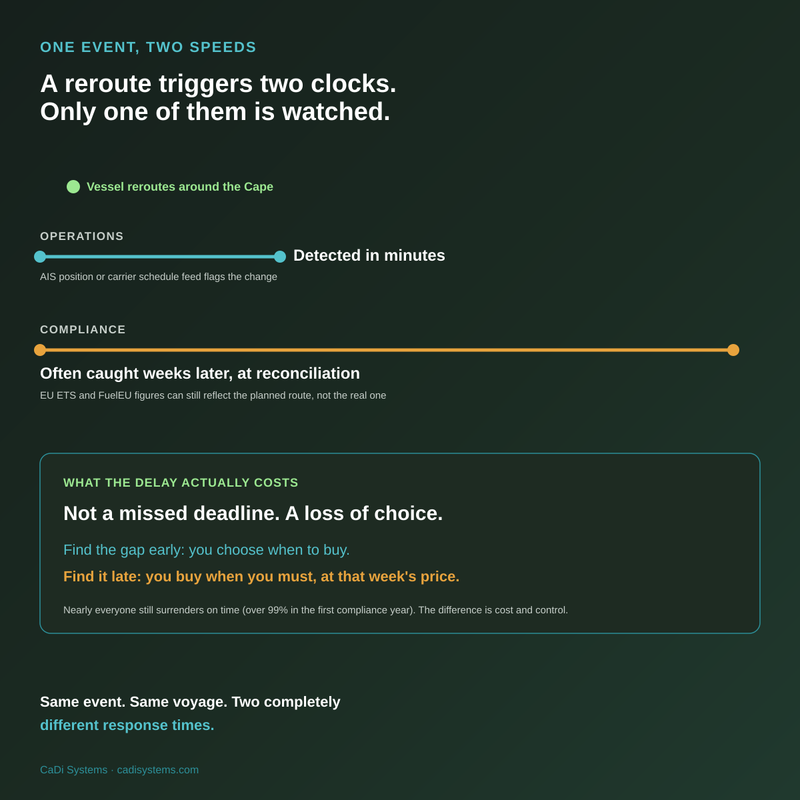
Operations sees a reroute in minutes. Compliance catches up weeks later. Find the gap early and you choose when to buy. Find it late and you take whatever the market charges that week.

Operations sees a reroute in minutes. Compliance catches up weeks later. Find the gap early and you choose when to buy. Find it late and you take whatever the market charges that week.
The short version: A route change breaks two things at once, a schedule and a compliance number, and in many organizations only one of them gets fixed right away. Operational teams see a reroute within minutes, through AIS data or a carrier notice. The EU ETS and FuelEU Maritime figures tied to that voyage are a different story: in many organizations, compliance is built around the planned route, and only reconciled against what actually happened at the next scheduled cycle. So far, nearly everyone has still surrendered their allowances on time. What the gap changes is the cost, because the later it's noticed, the less choice is left about when and how to close it.
What actually happens when Hormuz or Bab el Mandeb forces a reroute?
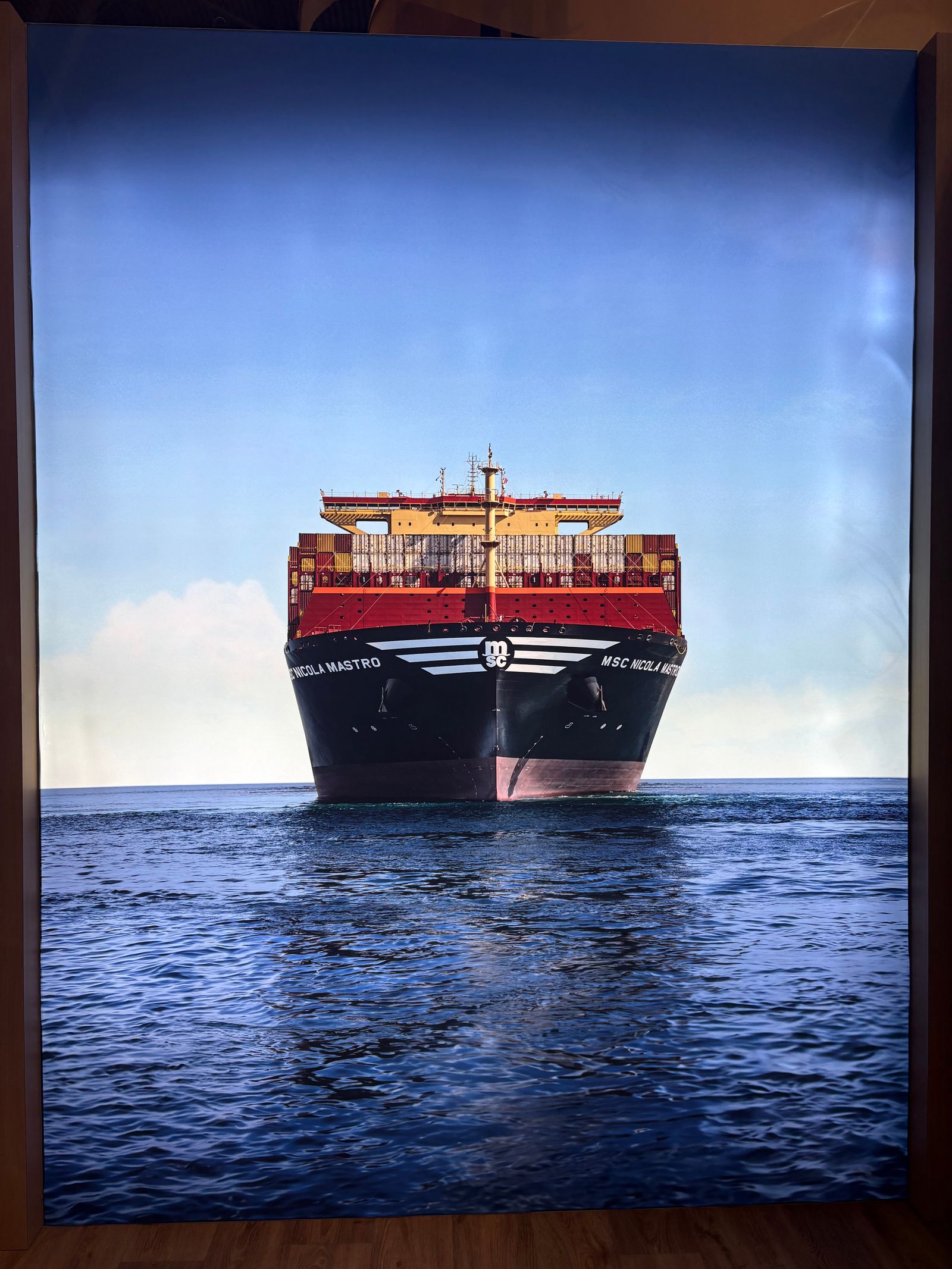
The Strait of Hormuz and the Bab el-Mandeb Strait are both under serious pressure at the same time right now, an active conflict involving Iran has disrupted transit through Hormuz, while Houthi forces have separately escalated attacks near Bab el-Mandeb, including capturing territory near the waterway. Carriers are rerouting around the Cape of Good Hope again, the same diversion used through 2024 and 2025. On an Asia-to-Europe voyage, that typically adds 8-12 days of transit time and real additional fuel burn compared to a Suez Canal transit.
Why does the schedule problem get noticed immediately?
In most operations, this part already works reasonably well. A vessel's AIS position or a carrier's own schedule feed shows a real delay or diversion, and that's visible, often within minutes, to anyone watching a tracking platform. The harder part isn't detecting the change. It's getting that single event to automatically update every booking, customer commitment, and downstream transport leg it affects, rather than relying on someone noticing it and manually working out what else needs to move.
Why doesn't the compliance number update at the same time?
This is the part that usually goes unnoticed. EU ETS allowance purchases and FuelEU Maritime compliance balances are often planned against a voyage's expected distance and fuel consumption, figures set when the route was booked, not when it actually sailed. Updating those figures to reflect what a vessel actually did, after a genuine reroute, means pulling real fuel and position data out of operational systems and feeding it back into a separate compliance process. In many organizations, that reconciliation happens on a schedule, such as a monthly close or quarterly reporting, rather than the moment the voyage itself changes.
Here's what that gap can cost. Many companies build up their EU ETS allowances through the year rather than in one lump sum, buying against what they expect to emit at whatever the market charges that day, currently around €86 per tonne. If a reroute's real fuel burn never gets fed back into that expectation, the company is quietly under-bought without anyone noticing. And the extra fuel counts: on a voyage into Europe, half of the voyage's emissions are in scope, including the extra fuel burned on a detour thousands of kilometres away. The gap only surfaces at reconciliation, by which point there's less room to choose when to buy. If a shortfall still isn't covered by the 30 September surrender deadline, the penalty doesn't replace the allowance cost, it stacks on top of it: the real market rate, plus €100 for every tonne still short. In practice, almost everyone gets there. The European Commission reported that shipping companies surrendered more than 99% of their required allowances by the deadline in the first compliance year. Nobody involved is being careless. The schedule change and the compliance recalculation simply live in two different systems, moving at two different speeds.
Here's the part that actually matters: it isn't that the number was wrong for a while, it's how much choice is left when someone notices. Under the EU ETS, nearly everyone gets there in the end. What differs is the route they took. A company that finds the gap early can buy when it chooses. One that finds it late buys when it must, at whatever the price is that week, which could be higher or lower than it would have chosen. FuelEU is harder-edged. Pooling, banking and borrowing have to be recorded by 30 April of the following year, and a deficit still open on that date becomes a penalty of €2,400 per tonne of VLSFO-equivalent. Same gap, same size. What changes the cost is how much room was left to act.
What changes when one event updates both?
The fix isn't making the compliance team check more often. It's removing the gap between the two processes entirely, so the same real event, the AIS position showing a vessel off its planned route, updates the operational record and the compliance calculation at the same moment, from the same primary data. A diversion's extra distance and fuel burn feed directly into the voyage's real EU ETS and FuelEU figures as it happens, not at the next scheduled reconciliation. The operational question, who needs to know the schedule changed, and the compliance question, what does this voyage actually owe now, get answered from the same captured event, rather than two separate processes that happen to be looking at the same ship.
Why will this keep happening after this crisis passes?
Hormuz and Bab el-Mandeb will not stay disrupted forever, but the underlying pattern will keep recurring, through whatever the next disruption turns out to be. Every rerouted voyage carries this same two-speed problem: a schedule change everyone notices quickly, and a compliance number that quietly stays wrong until someone goes looking for it. The organizations that handle this well won't be the ones with the fastest reconciliation team. They'll be the ones where there's no reconciliation gap to close in the first place.
See what one connected event actually updates
CaDi captures real operational events once, vessel position, fuel burn, schedule changes, and feeds both live operational visibility and audit-ready EU ETS and FuelEU figures from the same data, at the same time, not on two separate clocks. Talk to us about your operations..