
EU Carbon Regulations Explained, No Jargon, Just What You Need to Know
EU ETS, FuelEU Maritime, and CSRD explained in plain terms, with the real Scope 1-3 basics, real penalty figures, and real examples from live operators, not a lecture.

CARBON REGULATION · EXPLAINED SIMPLY
EU Carbon Regulations Explained, No Jargon, Just What You Need to Know
Scope 1, 2, and 3. EU ETS. FuelEU Maritime. CSRD. What they actually require, what the fines actually are, who's actually affected, and how the EU compares to Australia, California, Japan, and the IMO.
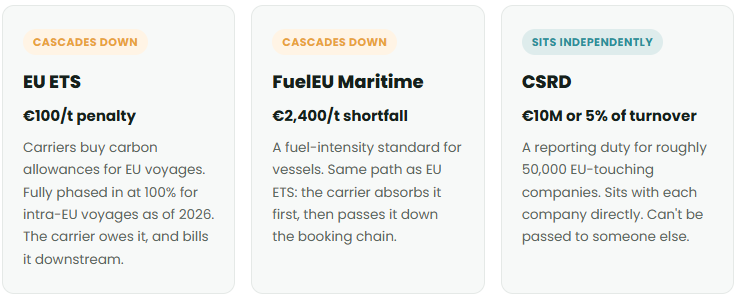
The short version: If you touch European logistics, three real regulations apply to you right now: EU ETS (a carbon price on shipping, up to €400,000 on a single voyage), FuelEU Maritime (a fuel-intensity penalty of €2,400 per tonne of shortfall), and CSRD (a reporting duty covering roughly 50,000 companies, with penalties reaching €10 million or 5% of global turnover in Germany, and real criminal liability for directors in France). Two of these cascade down the chain from carrier to forwarder to cargo owner. One doesn't, it sits with each company directly.
What do Scope 1, 2, and 3 actually mean?
This vocabulary comes from the GHG Protocol, and it shows up in every regulation on this page, so it's worth getting straight before anything else. Each scope describes whose emissions you're looking at, not how big they are.
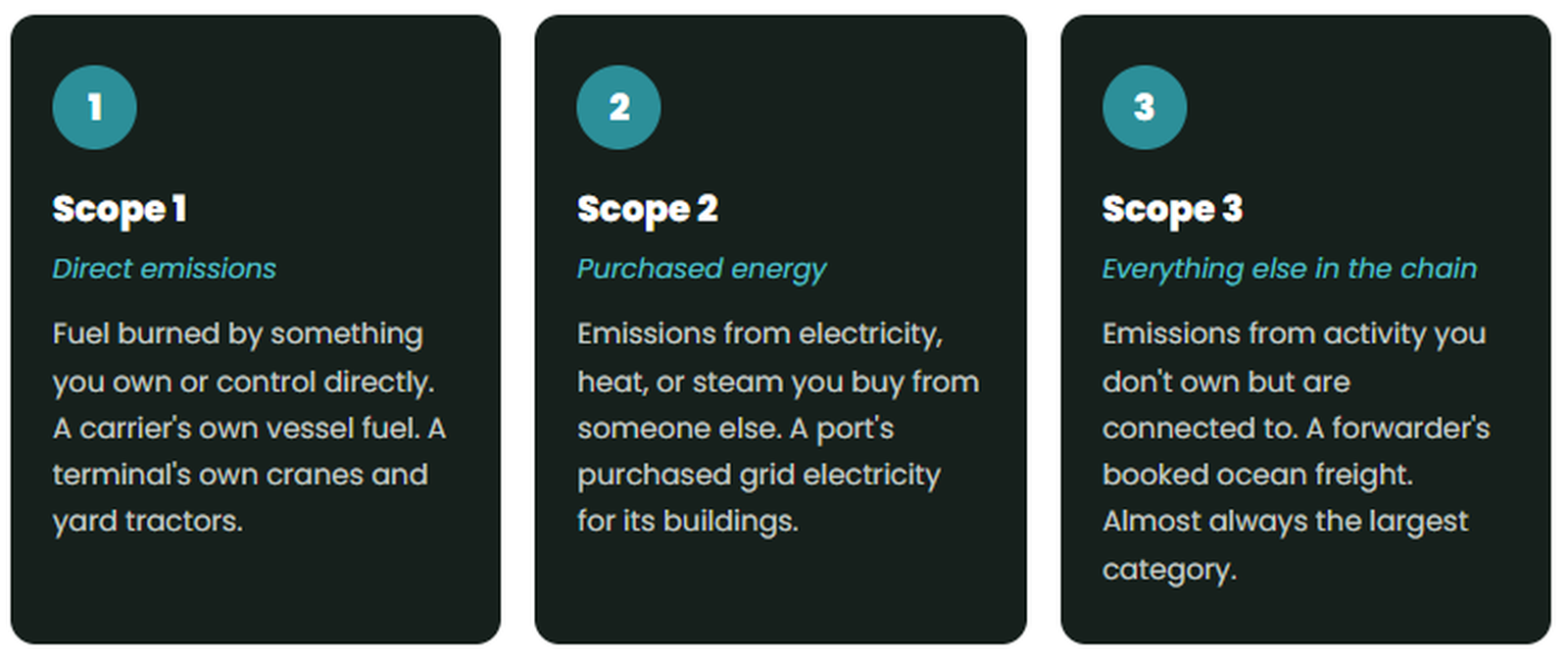
Why it matters: the same physical emissions are Scope 1 for whoever burns the fuel, and Scope 3 for everyone downstream who booked that activity. A carrier's fuel burn is the carrier's Scope 1, and simultaneously part of every one of its customers' Scope 3.
WHAT THIS LOOKS LIKE BEFORE IT'S SOLVED
“We used to wait days for container movement data from the ports — paper forms, double-handled, reconciled by hand.”
- East West Transport, Papua New Guinea
That's a real quote from a real carrier, describing exactly the gap between having a Scope 1 source (their own vessels and yard equipment) and actually being able to report on it cleanly.
What are the new EU regulations, in plain terms?
Three separate regulations, and they work in genuinely different ways. Two cascade down a commercial chain. One sits independently with whoever it applies to, and can't be passed on to anyone else.
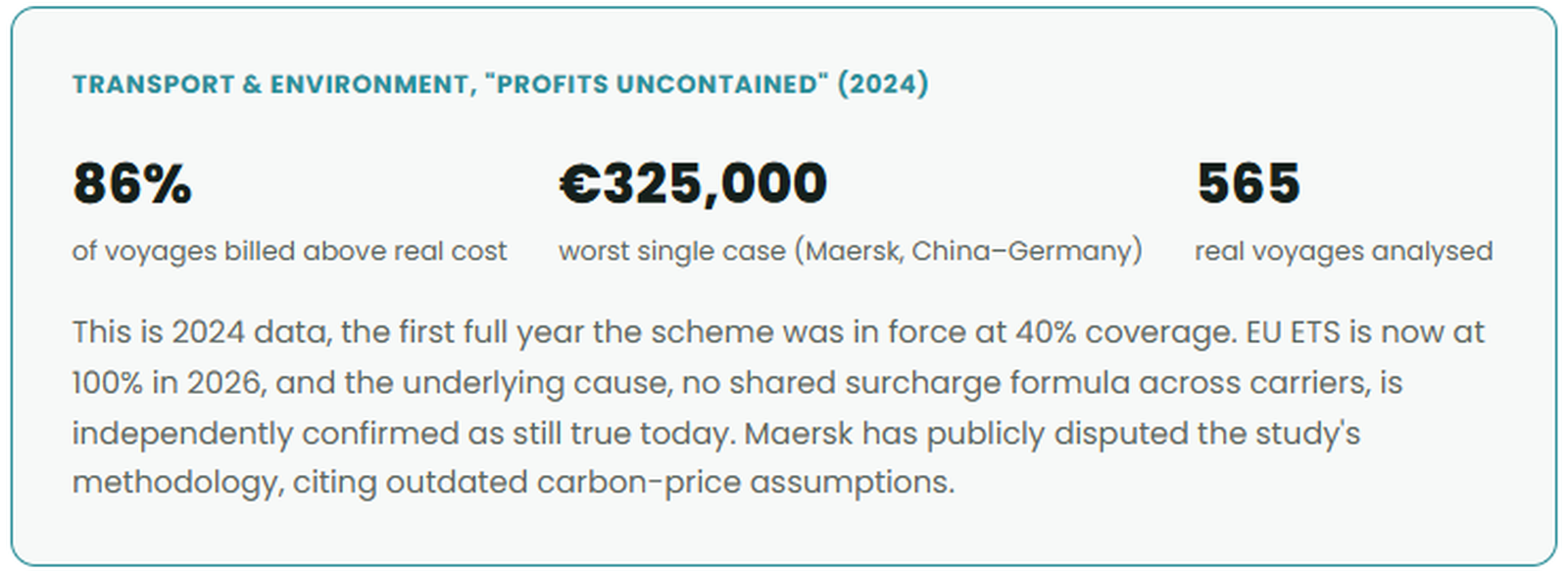
A real example: does the EU ETS bill you get actually reflect the real cost?
Not always, and this is independently verified, not just an assumption. Transport & Environment analysed 565 real container shipping voyages across four major carriers, comparing what was billed against each carrier's own estimated real carbon cost.
What are the actual fines?
These are the real, current figures, not projections.
|
Regulation |
Penalty |
Worth knowing |
|---|---|---|
|
EU ETS |
€100 per tonne CO₂e unsurrendered |
A single Asia-Europe voyage can carry a bill of up to €400,000 |
|
FuelEU Maritime |
€2,400 per tonne VLSFO-equivalent shortfall |
Roughly €642 per tonne CO₂e |
|
CSRD (Germany) |
€10 million or 5% of global turnover |
Whichever is higher |
|
CSRD (France) |
Up to 5 years imprisonment for directors, plus personal fines up to €500,000 |
Real criminal liability, not just a corporate fine |
Who actually has to deal with this?
Not everyone facing these rules has the same urgency, and it's worth being honest about that rather than pretending every case is equally acute.
Real, dated exposure
- Shipping companies carry direct EU ETS and FuelEU exposure, up to €400,000 on a single voyage, a real cost today.
- Large cargo owners and sustainability teams carry CSRD exposure directly, current law, not a future risk.
- Freight forwarders face a fast-moving commercial trigger: 80% of 2026 European shipper RFPs now require Scope 3 data before rate talks even start.
- Ports and terminal operators face a real, dated capital deadline: only 1 in 5 required onshore power connections across European ports are installed or even contracted, against a 2030 deadline.
A REAL EXAMPLE, PORTS & TERMINALS
“We were running the country's ports on paper. Now every container movement is captured in real time, offline at the wharf, landing clean data in customers' systems before the truck has left the yard.”
— JV Port Services, Papua New Guinea
Real, but not yet urgent
Smaller forwarders with no enterprise customer pushing yet, and ports below CSRD's institutional reporting thresholds, face a genuinely slower-burn version of this. Real, worth planning for, but not the same acute pressure as the cases above.
What about outside the EU?
The EU isn't alone here, and if your operations or your customers touch these markets, the same underlying vocabulary, Scope 1, 2, 3, applies, just under different names and different timelines.
|
Jurisdiction |
Framework |
Status |
|---|---|---|
|
Global (IMO) |
Net-Zero Framework, a carbon pricing mechanism for vessels over 5,000 GT |
Postponed once already (Oct 2025); re-scheduled vote in October 2026 |
|
Australia |
AASB S2 climate disclosure, building on existing NGER reporting |
Phased in by company size, 2025 through 2027; Scope 3 mandatory from each entity's second reporting year |
|
United States (California) |
SB 253 (emissions) and SB 261 (climate risk) |
Scope 1 and 2 reporting due for companies over $1B revenue; Scope 3 follows from 2027 |
|
Japan |
SSBJ sustainability standards, built on ISSB |
Legally mandatory from February 2026 for large Tokyo Stock Exchange Prime Market companies, phased by market capitalisation |
WORTH KNOWING
The IMO framework is genuinely still pending, it isn't law yet, and the vote has already been pushed back once. Everything else on this page is current, in-force regulation. Worth treating those two categories differently when you're deciding what to act on now versus what to simply keep watching.
Why does any of this actually matter?
Every one of these frameworks, EU or otherwise, depends on the same underlying thing: real, primary operational data that can be traced back to an actual event, not a spend-based estimate or a generic industry average. That's the part most operators are still missing, not the regulatory knowledge, the actual data capture underneath it. JV Port Services and East West Transport, both quoted above, are two real, live examples of what it looks like once that gap is closed.
See where your own data actually stands
CaDi captures real operational data once and turns it into audit-ready reporting across every framework on this page, from the same primary dataset, not six separate rebuilds.
Talk to us about your operations