Who Is Using AI Best in Logistics? Where It Works and Where It Doesn't
AI works best today on narrow, repeatable, document-heavy jobs in logistics where a person can check the result: reading documents, quoting, scheduling pickups.


The headline results are big, and most are unaudited. Here is what the evidence supports, where AI keeps failing, and why your data decides which side you land on.
The short version: AI works best today on narrow, repeatable, document-heavy jobs where a person can check the result: reading documents, quoting, scheduling pickups. In a survey of 200+ supply chain executives, 79.7% saw tangible impact from document extraction, but only 22.2% had deployed AI at scale and 62.8% had not measured the return. The loudest success story, C.H. Robinson, rests mostly on its own figures. Where AI struggles is exceptions, messy data and unmeasured projects. The same applies to emissions: an agent cannot add a fact nobody captured.
IN THIS ARTICLE
- Is AI actually working in logistics?
- Who is using it best?
- Where does it work?
- Where does it fall down?
- Why does your data decide the outcome?
- What should you ask before you buy or build an agent?
- What else do people ask?
Is AI actually working in logistics?
In places, yes. Mostly, nobody can prove how much. The best recent snapshot is a 2026 survey of more than 200 supply chain executives and practitioners by The Loadstar and Raft. Freight forwarders and 3PLs made up nearly half the sample. Raft is an AI logistics software company, so read it as an industry-side view, not a neutral audit.
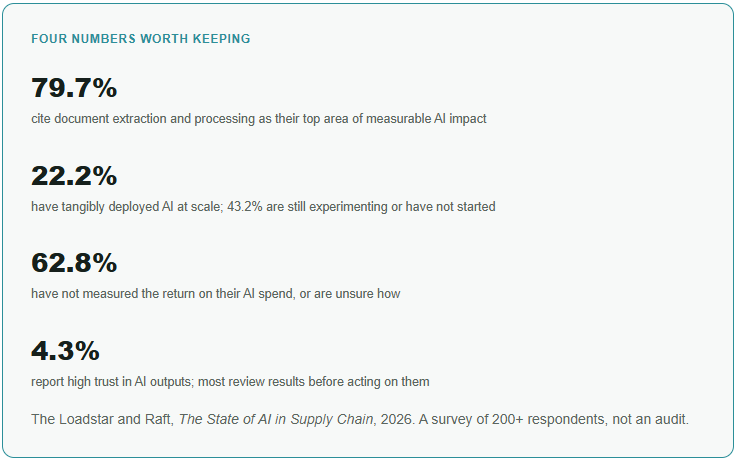
Read those together. The technology does something useful on paper work, but most companies cannot yet say whether it pays off, and almost nobody trusts it without checking.
Who is using it best and what do the case studies show?
Most of the new activity is in agentic AI: software that takes several steps toward a goal, such as reading an email, checking a rate and booking a pickup, rather than only answering a question. The name that comes up most is C.H. Robinson, the US freight broker. It is also the case where you most need to separate what the company says from what is independently shown.
|
Company |
What the AI does |
What the company says |
What is independently shown |
|---|---|---|---|
|
C.H. Robinson |
Quoting, order entry, pickup and delivery scheduling. Over 30 agents in 2025; "hundreds" by July 2026 |
A quote that took about 20 minutes of specialist time now takes 31 seconds. Productivity up 45% since 2022 (CEO, Fortune) or more than 60% (Q2 2026 release) |
Headcount fell from about 14,990 (Q1 2024) to about 12,085 (Q4 2025). No published method for the productivity figure; two statements two weeks apart give two numbers, possibly measured differently |
|
DHL Supply Chain (with HappyRobot) |
Appointment scheduling, driver follow-up calls, warehouse coordination |
"Thousands of emails and millions of voice minutes each year." "Measurable impact" |
No metrics published |
|
Uber Freight |
30+ agents; answers shipment questions, flags carriers and overpaid routes |
Its founder puts the insights tool at 98% accuracy, up from 60% to 70% in early versions (May 2025) |
Founder's figure; no external test found |
Sources: Fortune, 14 July 2026; C.H. Robinson Q2 2026 release; FreightWaves, 24 March 2026; Container News, 12 November 2025; TechCrunch, 21 May 2025.
What C.H. Robinson has reported is real: adjusted operating income up 20% in Q2 2026, and a North American truckload operating margin of 40.9% before restructuring costs. Its volumes have outgrown the Cass Freight Shipment Index for 13 quarters in a row. But it has also cut staff while revenue fell about 34% since 2023 in a weak freight market, so the earnings cannot be traced to AI alone. Its chief strategy and innovation officer, Arun Rajan, said in the same release: "This is not about automating tasks or taking people out of the process." Both things are in the record.
What looks copyable is how it works, not the headline number. It builds most agents in-house, with about 450 engineers, many with shipping experience. It maps a workflow and removes tasks that add no value before it automates the rest. And it plans for failure up front, using a failure-modes review, and reports progress only as green or red so that problems surface.
Where does it work?
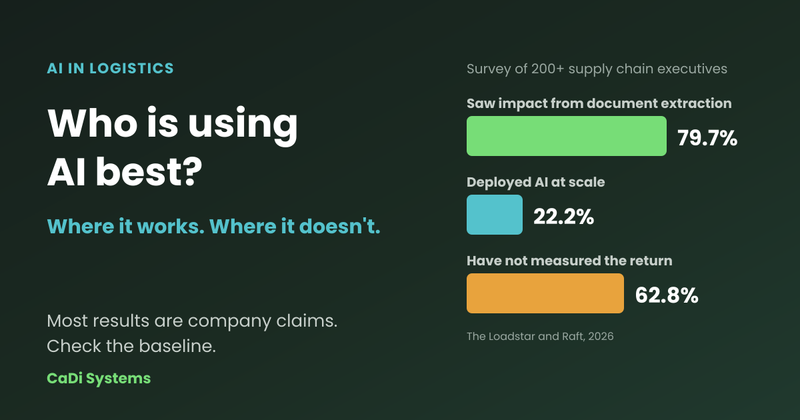
The pattern across the evidence is consistent. AI does best when the task is narrow, the input is a document or a message, the answer has a clear shape and a person can check it. That is why document extraction leads the survey at 79.7%, and why the DHL, Uber Freight and C.H. Robinson examples are all quoting, scheduling and follow-up calls.
It also works as glue. Among organisations already seeing results, 52.6% reported better collaboration between teams, and 89.5% pointed to speed and productivity as the return. That fits the unglamorous truth: logistics runs on emails, PDFs and phone calls, and AI is good at reading and writing them.
Where does it fall down?
Exceptions. The same survey found that only about 16% of respondents reported tangible impact in handling exceptions: 15.9% of forwarders and 3PLs and 15.6% of shippers, importers and exporters. Normal shipments are the easy part. Cost and risk sit in the ones that go off plan.
Integration and data. Among respondents who did not adopt AI or dropped it, two of the main reasons were integration complexity (29.9%) and data quality (27.8%). A separate survey by ORTEC, which sells optimisation software, put poor data quality at 22% and integration costs at 32% as barriers to agentic AI, with 42% of North American logistics leaders not yet exploring it. ORTEC has not published its method, so treat that as indicative.
Hype. In June 2025 Gartner predicted that over 40% of agentic AI projects would be cancelled by the end of 2027, citing rising costs, unclear returns and difficulty moving from prototype to production. It also said that of thousands of vendors claiming "agentic" products, only about 130 were genuine, the rest relabelling ordinary automation. That is a forecast, not a result, but it matches the survey: most teams cannot show the return.
Why does your data decide the outcome?
The Loadstar and Raft report puts it plainly: 65.8% of respondents expect data quality and integration to separate AI leaders from laggards. An agent reads whatever you feed it, and in logistics that is a mix of TMS records, spreadsheets, emails and scans, each with its own format.
Emissions are a clean example. Our last post showed that on one Singapore to Rotterdam sailing, a trade-lane average overstated the voyage-level figure by 47.6% (VesselBot, modelled), and that Sea-Intelligence found in 2024 that carrier calculators gave results up to 71% apart for the same container. An AI agent can write you a Scope 3 summary in seconds. It cannot know which port the ship called at, or how fast it sailed, if nobody recorded it. It will give you a fluent answer built on the average, and fluent is not the same as defensible.
CaDi is a data layer for low-carbon logistics. It captures an operational event once, calculates what it means for emissions using its own calculation engine based on GLEC v3.2 and ISO 14083, and passes the result to the systems that need it. The figure comes from a stated method, not from a model's best guess, and it leaves an auditable record. That record is what any agent, or any person, should be working from. CaDi sells emissions software, so weigh our view accordingly.
What should you ask before you buy or build an agent?
The projects that survive tend to answer a few plain questions before they start:
- What exact task is it doing, and what does "done" look like? Narrow beats ambitious.
- What data does it read, and who owns it? Is that data captured once, or retyped from a PDF?
- Who checks the output, and what happens when it is wrong? Ask for the audit trail.
- What was the baseline before, and how will you measure after? Without one, you join the 62.8% of survey respondents who cannot say whether their AI paid off.
- How does it handle the exceptions? That is where the cost is, and where the survey says AI is weakest.
Write the answers down before the pilot starts. A pilot with no baseline is a demo.
What else do people ask about AI in logistics?
What is agentic AI in logistics?
Software that takes several steps toward a goal, such as reading an email, checking a rate and booking a pickup, rather than only answering a question. Gartner has warned that many products sold as agentic are relabelled automation: of thousands of vendors making the claim, it counted about 130 as genuine.
Will AI agents replace logistics staff?
The evidence is mixed. C.H. Robinson's headcount fell from about 14,990 in Q1 2024 to about 12,085 in Q4 2025 while it expanded its AI agents, and it has not hired replacements for departing workers where agents now do the work (Fortune). Its executives also say the aim is not to take people out of the process. We found no independent study that separates the effect of AI from a weak freight market.
Where should a forwarder or terminal start with AI?
Where the evidence is strongest: document extraction and routine messages, with a person checking the output. In the Loadstar and Raft survey 79.7% cited document extraction as their top area of measurable impact, against about 16% for handling exceptions. Set a baseline first, so you can tell whether it paid off.
Why do so many AI projects in logistics stall?
The survey points to integration and data quality, a shortage of expertise and change management (53.8% cite it as the top scaling blocker), and no measurement of the return (62.8%). Gartner forecast in 2025 that over 40% of agentic AI projects would be cancelled by the end of 2027, mainly on cost, unclear value and the difficulty of reaching production.
Bring one movement and one data feed
If you want to see what an auditable emissions record looks like, we can walk through one real movement with you, using a sample export from the systems you already run. No replacement, no rip-out, and no commitment beyond the conversation.