Will the IMO Net-Zero Framework change what you pay for freight? What to know before 4 December
Not yet, and probably not before 2028. The IMO Net-Zero Framework, a global fuel standard with a carbon charge for shipping, has been approved in draft but not adopted.

The short answer: Not yet, and probably not before 2028. The IMO Net-Zero Framework, a global fuel standard with a carbon charge for shipping, has been approved in draft but not adopted. Countries may try again on 4 December 2026. Until then, the emissions charges on your quotes come from EU rules, not the IMO.
Where does the vote stand?
Adoption failed once and is back on the table.
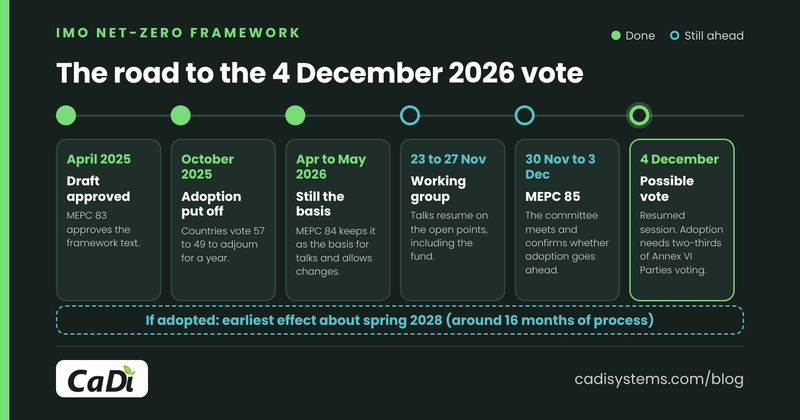
- April 2025: the IMO’s environment committee (MEPC 83) approved the draft.
- October 2025: adoption was put off for a year, after a 57 to 49 vote to adjourn.
- April to May 2026: MEPC 84 kept the framework as the basis for talks and let countries propose changes.
- 23 to 27 November 2026: a working group meets again.
- 30 November to 3 December 2026: MEPC 85 meets.
- 4 December 2026: a resumed extraordinary session, where adoption could be taken up, subject to confirmation at MEPC 85.
Adoption needs two-thirds of the countries present and voting, and only the 108 countries that are party to MARPOL Annex VI can vote. The September talks ended without agreement on the fund or the fuel standard. The EU, the UK, Australia, Brazil and Pacific island states back the framework. The US, Saudi Arabia and the UAE oppose it. Treat the outcome as open.
What would the framework actually do?
It would set a yearly limit on how greenhouse-gas-intensive a ship’s fuel can be, and charge ships that miss it.
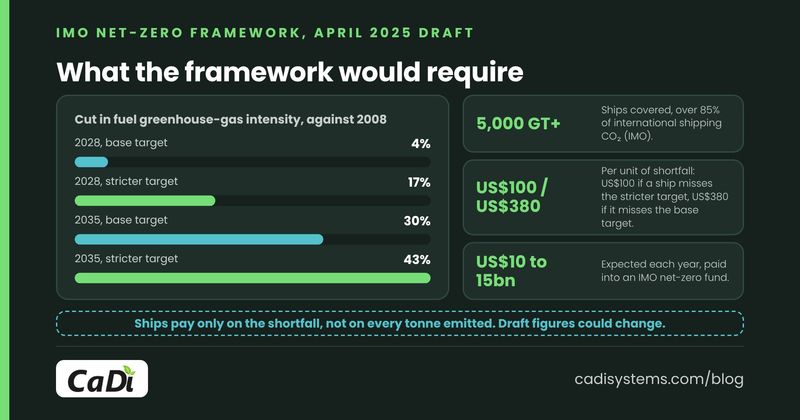
- Which ships: those of 5,000 gross tonnes and above, which the IMO says produce over 85% of global shipping emissions.
- Targets, against 2008: a base target of 4% in 2028 rising to 30% in 2035, and a stricter target of 17% in 2028 rising to 43% in 2035.
- What ships pay: only on the shortfall, not on every tonne emitted. A ship that meets the base target but misses the stricter one pays US$100 per unit. A ship that misses the base target pays US$380 per unit.
- Where the money goes: an IMO net-zero fund, expected to raise US$10 to 15 billion a year.
These figures come from the April 2025 draft and could change before any vote.
Will it show up on my freight bill?
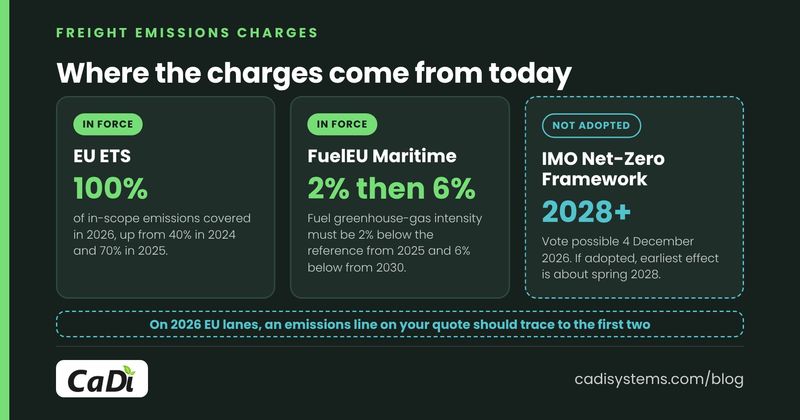
Not today. Nothing is payable under the framework yet, and as of mid-October no carrier had published an IMO surcharge. If countries adopt it on 4 December, the earliest it could take effect is about spring 2028, because the IMO’s amendment process takes around 16 months.
It would also not automatically replace the EU ETS. EU law would have to change first, after a Commission review.
What you pay for emissions today comes from two EU rules:
- EU ETS: from 2026, carriers surrender allowances for 100% of in-scope emissions, up from 40% in 2024 and 70% in 2025.
- FuelEU Maritime: fuel greenhouse gas intensity must be 2% below the reference from 2025, and 6% from 2030.
What should forwarders and shippers do now?
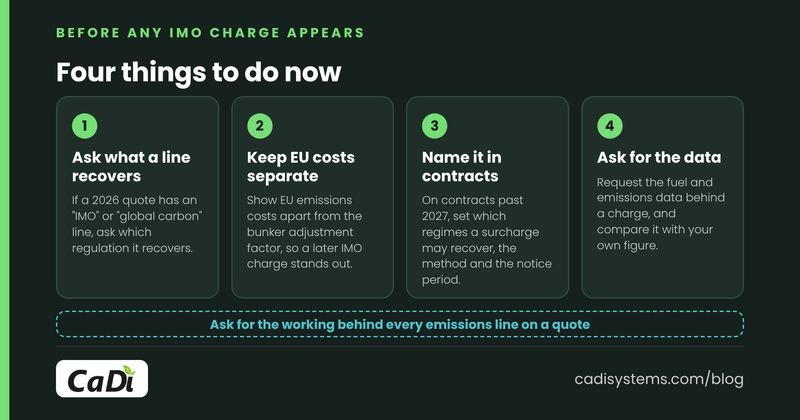
Ask for the working behind every emissions line on a quote.
- If a 2026 quote has an “IMO” or “global carbon” line, ask which regulation it recovers. On Europe lanes it should be the EU ETS or FuelEU.
- Keep EU emissions costs separate from the bunker adjustment factor, so a later IMO charge is easy to spot.
- On contracts that run past 2027, name which regimes a surcharge may recover, the calculation method and the notice period.
- Ask carriers for the fuel and emissions data behind a charge, and keep your own figure for each shipment to compare it with.
Where CaDi fits
Whatever the IMO decides, the work on your side is the same: a number for each shipment that you can trace back to the trip, the method and the check. That is what CaDi Systems, the data layer for low-carbon logistics, is built for. The trip is captured once, and the emissions are calculated from that same data, not rebuilt from a second, disconnected set.
Questions people ask
Is the IMO Net-Zero Framework in force? No. It was approved in draft in April 2025 and has not been adopted.
When is the vote? Possibly 4 December 2026, at a resumed extraordinary session, subject to confirmation at MEPC 85 (30 November to 3 December).
Does it replace the EU ETS? Not automatically. The EU would have to change its own law.
Does it apply to every ship? No. It covers ships of 5,000 gross tonnes and above. Domestic-only ships are excluded.
Sources
- IMO, The IMO Net-Zero Framework: FAQs: ships covered, adoption by two-thirds of Annex VI Parties, the 16-month process.
- IMO, IMO progresses work on ship emissions, pollution and ocean protection: the November and 4 December 2026 meeting dates.
- CargoLinked, IMO Net-Zero Framework: October 2026 status for shippers (13 October 2026): dates, draft targets, prices, entry-into-force timing, EU rules.
- gCaptain, IMO net-zero framework holds ground after latest round of climate talks (4 September 2026): September talks, who supports and opposes it, the 57 to 49 vote.
- Ship & Bunker, ISWG-GHG 22 working group ends (September 2026): November and December meeting dates.
- Carbon Brief, Q&A: how countries got the global net-zero shipping deal back on track (5 May 2026): the framework’s targets, prices, fund and positions.