ISO 14083 is now EU law. What changes for freight, and when?
ISO 14083 is now EU law. Regulation (EU) 2026/1030, in force since 1 June 2026, makes it the single method for any transport emissions figure that is shared commercially, by contract or under law.

The short answer
ISO 14083 is now EU law. Regulation (EU) 2026/1030, in force since 1 June 2026, makes it the single method for any transport emissions figure that is shared commercially, by contract or under law. Most of it applies from 2 December 2030. It does not force anyone to calculate, but anyone who does must follow it.
What actually happened?
The EU has passed a law on how to count transport emissions. Its official name is Regulation (EU) 2026/1030 on the greenhouse gas emissions accounting of transport services. People call it CountEmissionsEU.
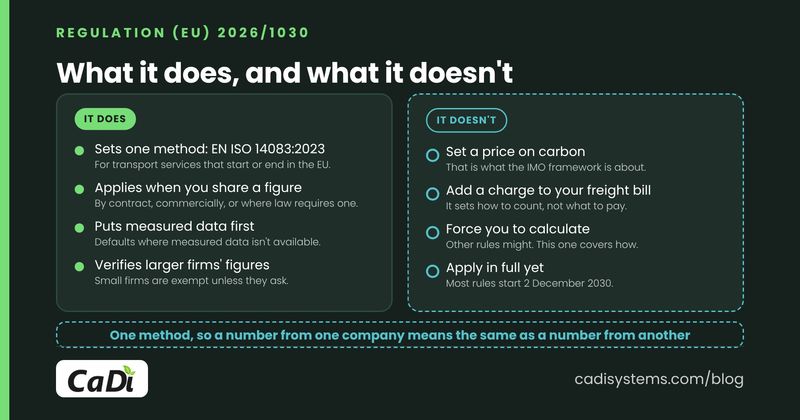
It does not set a carbon price. It does not add a charge to your freight bill. It sets one way to count, so that a number from one company means the same as a number from another.
The method is EN ISO 14083:2023, based on an international standard. That matters outside Europe too: ISO 14083 is not an EU invention, so the same method works elsewhere.
What are the key dates?
- 5 November 2025: Parliament and Council reach a provisional deal.
- 29 April 2026: the date of the Regulation.
- 12 May 2026: it is published in the Official Journal.
- 1 June 2026: it enters into force.
- 2 June 2028: the EU’s database of emission factors for fuels and energy is due.
- 2 December 2029: the EU’s database of default emission values is due.
- 2 June 2030: the Commission must adopt the rules for its free calculation tool.
- 2 December 2030: most of the rules apply.
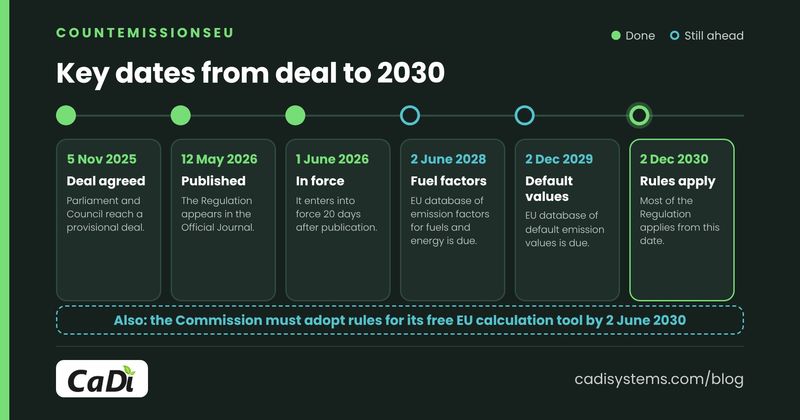
The gap between “in force” and “applies” is the point. You have until December 2030 for the formal rules. Customers can ask for the method sooner, in tenders and contracts.
Who does it cover?
Transport services that start or end in the EU. It covers carriers, the companies that organise transport, ports and terminals (hub operators), data intermediaries, calculation tool makers, and the bodies that verify figures. Shippers are in if they calculate or disclose transport emissions.
It applies when a figure is shared by contract or voluntarily for commercial reasons, or when other EU or national law requires it. So a quote, a tender response, a customer report or a sustainability claim can all fall under it.
Does it make me report my emissions?
No. This law doesn’t force you to calculate. Other rules might, such as company sustainability reporting. But once you share a figure, you have to use the method.
What is different about the method?
It is about the whole trip, not one leg of it. It counts the energy used to make the fuel as well as the fuel burned. And it prefers measured data over estimates.
- Measured data comes first. Real fuel, distance and load. Estimates and defaults are allowed where measured data isn’t available.
- Default values will come from the EU. The Commission is building the databases to supply them.
- Figures must be checkable. Larger companies’ figures must be verified by an accredited body. Small and medium companies are exempt unless they ask for it.
- Calculation tools need certifying. Third-party tools used for this purpose have to be certified, according to the industry body ALICE’s summary of the final text. Check the details when the Commission publishes its list.
How is this different from the IMO?
The IMO framework is about a price on shipping’s emissions. It is still not adopted. This EU law is about the count. One tells you what you might pay. The other tells you how to measure what you used.
They connect. A price needs a fair number behind it. If your carrier cannot show how its figure was worked out, you are in the same position whichever rule applies.
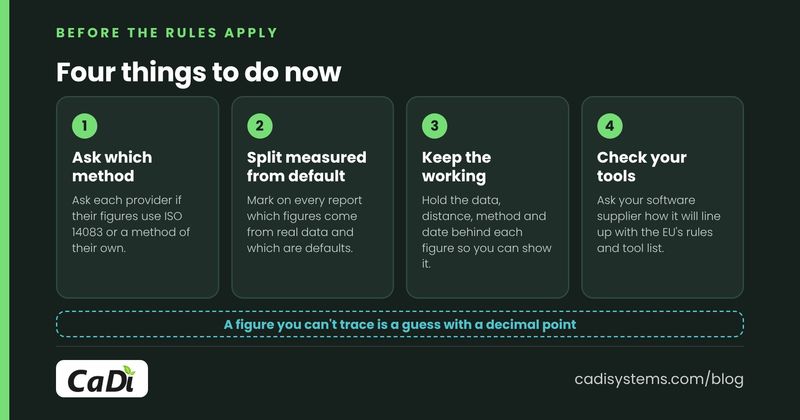
What should forwarders and shippers do now?
- Ask each provider which method they use. ISO 14083 or something of their own?
- Separate measured figures from default ones. Mark which is which on every report.
- Keep the working. Hold on to the data, the distance, the method and the date for every figure.
- Check your tools. Ask your software supplier how it will line up with the EU’s rules and tool list.
Where CaDi fits
CaDi Systems is the data layer for low-carbon logistics. CaDi works out emissions for each shipment on its own engine, built on GLEC v3.2, ISO 14083 and the GHG Protocol, and keeps the working so you can show it. GLEC v3.2 is the industry guidance that stays aligned with ISO 14083. It can write the figure back into your own system, including CargoWise. Talk to us if you want to test it on your own shipments.
Questions people ask
Is ISO 14083 now mandatory in the EU? Only when you share a transport emissions figure commercially, by contract, or where law requires one. Then it is the method you must use. Most of the rules apply from 2 December 2030.
Does it apply to ocean freight? Yes. It covers transport services that start or end in the EU, across modes. The IMO decision is separate and covers the price on shipping emissions.
Do I need to use measured data? Measured data comes first. You can use defaults where measured data isn’t available, and the EU is building the default databases.
Does it apply outside Europe? It applies to services that start or end in the EU. ISO 14083 itself is an international standard, so the same method works elsewhere.
Sources
- Regulation (EU) 2026/1030, EUR-Lex (primary source). Dates and articles also read in the Official Journal text, 12 May 2026.
- IRU: EU adopts rules on transport emissions accounting, 28 April 2026.
- ALICE: CountEmissionsEU implications for logistics.
- Gruia Dufaut: CountEmissionsEU, rules applicable from 2030.
- IEU Monitoring: co-legislators agree single method, 5 November 2025.
- Searoutes: GLEC Framework v3.2.