Can You Check Your EU ETS Surcharge? One Route, Two Numbers
Carriers add a carbon surcharge, and your Scope 3 report leans on their emissions data. On one real route, neither can be checked from the outside. Here is what to ask for.

This is important. Carriers add a carbon surcharge, and your Scope 3 report leans on their emissions data. On one real route, neither can be checked from the outside. Here is what to ask for.
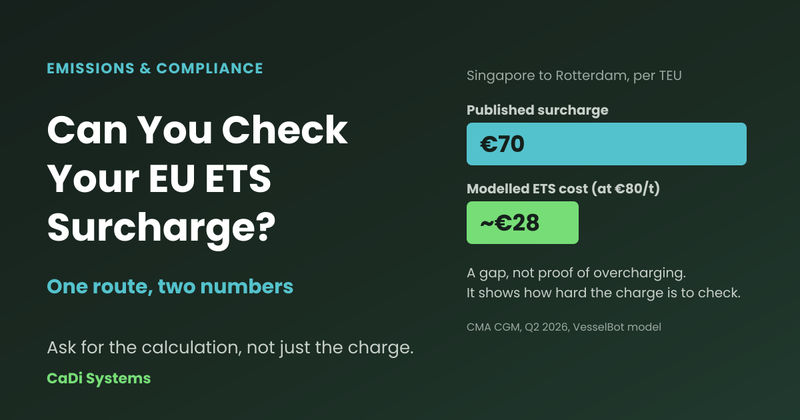
The short version: No, not from the outside. Carriers pass the EU ETS cost on as surcharges that vary widely and come with little explanation. On Singapore to Rotterdam, one analysis models the ETS cost at about €28 per container (TEU) against a published surcharge of €70. That gap is not proof of overcharging, because surcharges can also carry FuelEU Maritime and other costs. The same missing detail, such as which ports the ship calls at and how fast it sails, also skews your Scope 3 number. Ask for the calculation basis, the port rotation, and whether your emissions figure is for your voyage or a lane average.
IN THIS ARTICLE
- What is the EU ETS surcharge, and why is it hard to check?
- What does one route show?
- Why does the port rotation matter?
- How does the same problem reach your Scope 3 number?
- What can you ask your carrier or forwarder?
- What else do people ask?
What is the EU ETS surcharge, and why is it hard to check?
Under the EU Emissions Trading System (EU ETS), shipping companies must buy allowances for emissions on voyages to, from and within the EU. Since 2026 that covers 100% of in-scope emissions: all of it within the EU and at berth, and 50% on voyages between an EU and a non-EU port (UK P&I Club). Carriers recover the cost through surcharges they set themselves. In late 2023 an S&P Global analyst noted that none of the carriers had explained why their surcharges differed, with Asia to Europe figures running from €12 to €70 per TEU.
Transport & Environment (T&E), which we cited on 28 September, estimated in 2024 that carriers charged more than their ETS cost on nearly 90% of 565 voyages. It assumed €90 a tonne when the market was about €65, and the carriers called the data inaccurate. That makes it a claim, not a test. Can anyone test it with 2026 data?
What does one route show?
VesselBot, a maritime data company, modelled more than 20,000 EU-linked container voyages in Q2 2026 and compared the modelled ETS cost with CMA CGM's published surcharges. It sells emissions analysis and we have not reproduced its model, so treat the figures as estimates. Motorship and AJOT reported the same analysis, which makes it one source, not several.
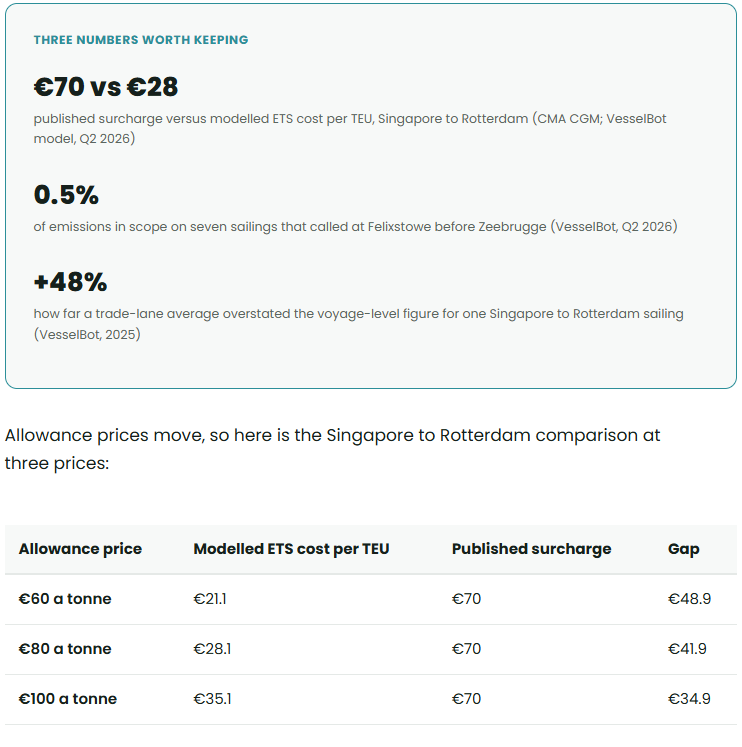
CMA CGM, direct sailings, Q2 2026. Modelled costs from VesselBot as reported by ShipUniverse; the gap column is our subtraction.
Even at €100 a tonne the modelled cost is about half the surcharge. That does not mean the carrier overcharged. The model counts ETS only, and a surcharge may also cover FuelEU Maritime, fuel costs and the carrier's own commercial assumptions. One carrier, one quarter, one model. From the outside you cannot tell, and that is the point.
Why does the port rotation matter?
The scheme counts voyages by where they start and end. VesselBot looked at seven CMA CGM sailings from Singapore that called at Felixstowe in the UK before Zeebrugge. The UK is outside the EU, so only the short hop into Zeebrugge counted: 451 of 89,949 tonnes of CO₂e (0.5%), roughly €5,000 a sailing. AJOT reports that the published surcharge on that service stayed fixed.
Seven sailings is an illustration, not a rule. But it shows why a flat per-TEU charge is hard to test without knowing which rotation your box took. Our 5 October post covers what happens when routes change.
How does the same problem reach your Scope 3 number?
Your Scope 3 inventory includes the emissions of the transport you buy (GHG Protocol, Category 4). The surcharge is a cost and Scope 3 is emissions, but both depend on the same voyage facts, and the shipper often gets the emissions figure from the carrier. VesselBot compared averages with its voyage-level figure for one Ever Arm sailing, Singapore to Rotterdam, January 2025:
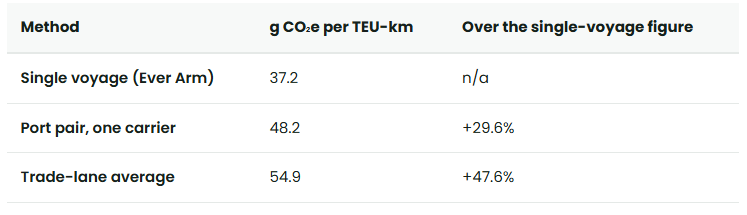
VesselBot, "Shippers' Scope 3 emissions exposure and the pitfall of aggregates". VesselBot's own platform data, modelled and not independently verified.
The coarser the average, the bigger the gap. Method matters too: Sea-Intelligence found in 2024 that carrier carbon calculators gave results up to 71% apart for the same container, mainly because of method, not ships.
One regulatory note. Under Directive (EU) 2026/470, in force since 18 March 2026, mandatory CSRD reporting covers only companies with more than 1,000 employees and €450 million in turnover. Fewer shippers must now report Scope 3, but those that do, and their suppliers, still need numbers they can defend. This is not legal advice, so check your own position.
What can you ask your carrier or forwarder?
Full shipment-level disclosure is hard: VesselBot's chief executive told Motorship it involves commercially sensitive data and thousands of shipments a day. But you can ask for more than a number:
- What share of my voyage is in scope? Ask for the port rotation, not just origin and destination.
- What allowance price and review cycle does the charge assume?
- What else is in it? FuelEU Maritime, fuel or other costs.
- Is my emissions figure for my voyage, or a lane average? And which method sits behind it, such as ISO 14083 or the GLEC Framework?
- How does the same lane look across two carriers? A spread of several times is a reason to ask why.
Keep the answers. A record of what you were told, and when, is worth more than a one-off argument about fairness.
CaDi is a data layer for low-carbon logistics. It captures an operational event once, calculates what it means for emissions, and passes the result to the systems that need it. It will not tell you whether a surcharge is fair, and we are not claiming carriers overcharge. It gives a terminal or forwarder an auditable record of its own movements, which is the starting point for any check. CaDi sells emissions software, so weigh our view accordingly.
What else do people ask about EU ETS surcharges?
How is the EU ETS surcharge on container shipping calculated?
Carriers set their own surcharges and mostly do not publish a formula. The underlying cost depends on the emissions of the voyage, the share of it inside the scheme (100% within the EU and at berth, 50% between an EU and a non-EU port) and the allowance price. A surcharge may also include FuelEU Maritime or other costs.
How much is the EU ETS surcharge per container in 2026?
It varies by carrier and route. Searoutes, which sells ETS tools, reported first-quarter 2026 surcharges per TEU from East Asia to North Europe of $82 to $93 across four carriers, and from $16 to $83 within North Europe. For CMA CGM from Singapore, VesselBot cites published charges of €56 to Valencia and Piraeus and €70 to Rotterdam. Check your carrier's current notice.
Is the EU ETS surcharge higher than the carrier's actual cost?
Public data cannot settle it. Transport & Environment estimated in 2024 that carriers charged more than their ETS cost on nearly 90% of 565 voyages sampled, and the carriers disputed that. A 2026 vendor model for one carrier on three routes put the ETS cost at about 40% to 55% of the published surcharge, but surcharges can legitimately include other costs such as FuelEU Maritime. Neither study is an audit.
Can I work out my Scope 3 emissions from an ETS surcharge?
No. The surcharge is a cost that depends on the allowance price, the share of the voyage in scope and anything else the carrier includes. Scope 3 needs the emissions of the whole journey, which should come from voyage-specific data or a stated method such as ISO 14083 or the GLEC Framework.
Bring one route and one invoice
If you want to see what a defensible emissions record looks like, we can walk through one route with you, using a sample export from the systems you already run. No replacement, no rip-out, and no commitment beyond the conversation.