Audit-ready logistics emissions data: 7 questions to ask any carrier or vendor
A logistics emissions number is audit-ready when an outsider could rebuild it from its inputs. That means the source records, the method and version used, and a clear statement of what was counted.


A logistics emissions number is audit-ready when an outsider could rebuild it from its inputs. That means the source records, the method and version used, and a clear statement of what was counted. If a carrier or vendor cannot show you those three things, treat the number as an estimate.
This matters more each year. Customers send questionnaires, auditors ask for evidence, and carbon costs now appear on freight invoices. The seven questions below work for any carrier, forwarder or software vendor, including us.
The short version
- Ask which standard and version the number follows, not just whether it is "aligned".
- Ask whether each figure is built from primary, default or modelled data.
- Ask what was counted, how it was shared across shipments, and whether you can trace it to a source event.
- Ask who has independently checked it.
1. Which standard does the number follow, and which version?
The standard should be named, with its version. For freight that usually means ISO 14083, the international standard for quantifying transport emissions, and the GLEC Framework from Smart Freight Centre, which applies it to logistics.
- A good answer: "GLEC Framework v3.2 and ISO 14083", plus the date the method was last updated.
- A red flag: "industry standard" or "best practice". "Aligned with" is also weaker than "conforms to".
2. Is the data primary, default or modelled?
Primary data is recorded from the actual trip: the fuel burned, the distance, the load, the vessel and the voyage. Default data is a standard average, used when real data is not available. Modelled data is estimated from other inputs. All three can be valid. Each one should be labelled.
- A good answer: each figure says which kind it is, and the report states the share that is primary data.
- A red flag: one blended number with no label. You cannot tell a measured figure from a guess.
3. What was counted?
The boundary decides the number. Freight emissions should cover the full fuel chain, from producing the fuel to burning it, expressed in CO2e. They should also include empty running, part-loaded trips, repositioning and out-of-route distance.
- A good answer: a written boundary that lists what is in and what is out.
- A red flag: a figure that counts only the fuel burned at the exhaust, or ignores empty legs.
Two honest numbers for the same route can differ only because their boundaries differ. That is one reason figures are hard to compare. For a real route where neither the surcharge nor the emissions figure could be verified, see Can You Check Your EU ETS Surcharge?
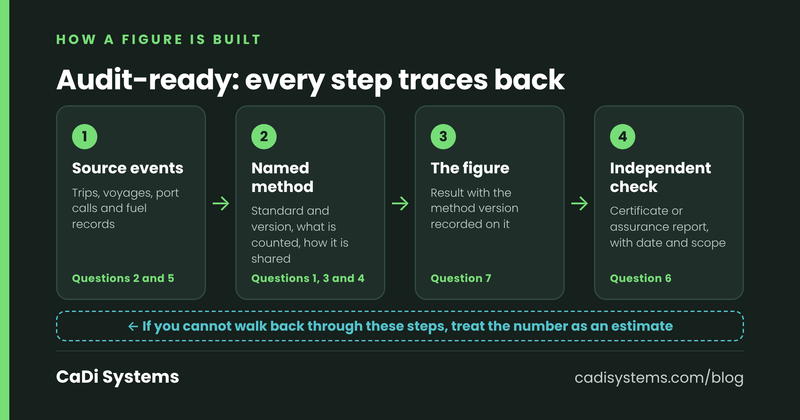
4. How was the total shared across shipments?
A ship, truck or train carries many consignments at once. The emissions for the whole trip have to be split between them using a stated rule, such as weight, volume, containers or pallets.
- A good answer: it names the rule and applies it the same way every time.
- A red flag: "we use an average", without saying an average of what.
5. Can you trace the figure to a source event?
Every number should lead back to the records behind it: the trip or voyage, the port call, the fuel record and the date. If you cannot get from the total to those records, nobody can check it.
- A good answer: you can open a figure and see the events it was built from.
- A red flag: a PDF with a total and no way in.
6. Has anyone independent checked it?
Smart Freight Centre certifies logistics emissions calculation and reporting tools. It checks that the method conforms to ISO 14083 and correctly applies the GLEC Framework. External assurance of a company's own report is a second kind of check. Ask which one applies, and ask for the document.
- A good answer: a named certificate or assurance report, with a date and a scope.
- A red flag: "built to the standard", with no outside check behind it.
7. Will the number come out the same next time?
Methods and fuel factors get updated. A figure you reported last year should still be explainable today.
- A good answer: the method version is recorded on every result, and changes are logged.
- A red flag: results that shift silently when a database updates.
If you only have time for two questions, ask number 2 and number 5. Together they separate measured data from guesses faster than any other pair.
Estimate or audit-ready: a side-by-side
Use this table to score any emissions figure you are shown. Mostly left-hand answers mean an estimate.
|
Question |
An estimate |
Audit-ready |
|---|---|---|
|
Standard and version |
"Industry standard" |
Named standard and version, such as GLEC v3.2 and ISO 14083 |
|
Type of data |
One blended number |
Each figure labelled primary, default or modelled |
|
What is counted |
Not stated |
Written boundary, including the full fuel chain and empty running |
|
Sharing across shipments |
"An average" |
A named rule, applied the same way every time |
|
Traceability |
A total in a PDF |
Each figure opens to its source events |
|
Independent check |
"Built to the standard" |
A certificate or assurance report with date and scope |
|
Repeatability |
Results move silently |
Method version recorded, changes logged |
Frequently asked questions
What does audit-ready mean for emissions data?
It means an outside reviewer could rebuild the number from its inputs. They would find the source records, the method and version, and a clear statement of what was counted.
What is the difference between primary and default data?
Primary data is recorded from the actual trip, such as fuel burned, distance and load. Default data is a standard average used when real data is not available.
Is the GLEC Framework the same as ISO 14083?
No. ISO 14083 is the international standard for quantifying and reporting greenhouse gas emissions from transport chain operations. The GLEC Framework, from Smart Freight Centre, applies it to logistics. Smart Freight Centre certifies tools against both.
Can I use default values?
Yes. When carrier data is not available, the GLEC Framework provides default intensities. Label them as default, and replace them with primary data where you can.
Who certifies a logistics emissions calculation tool?
Smart Freight Centre assesses tools and certifies those that conform to ISO 14083 and the GLEC Framework. The service was previously called accreditation.
How CaDi answers these questions
We built CaDi's data layer around these seven questions, and we would rather you ask us than take our word. An event is captured once. Emissions are calculated from that same data on our in-house engine, and every figure traces back to its source. Our method follows GLEC v3.2 and ISO 14083.
If you want to see it on real data, book a demo.
Related reading
- Can You Check Your EU ETS Surcharge? One Route, Two Numbers
- When Routes Change, Your Carbon Number Doesn't
- EU carbon regulations explained
Sources